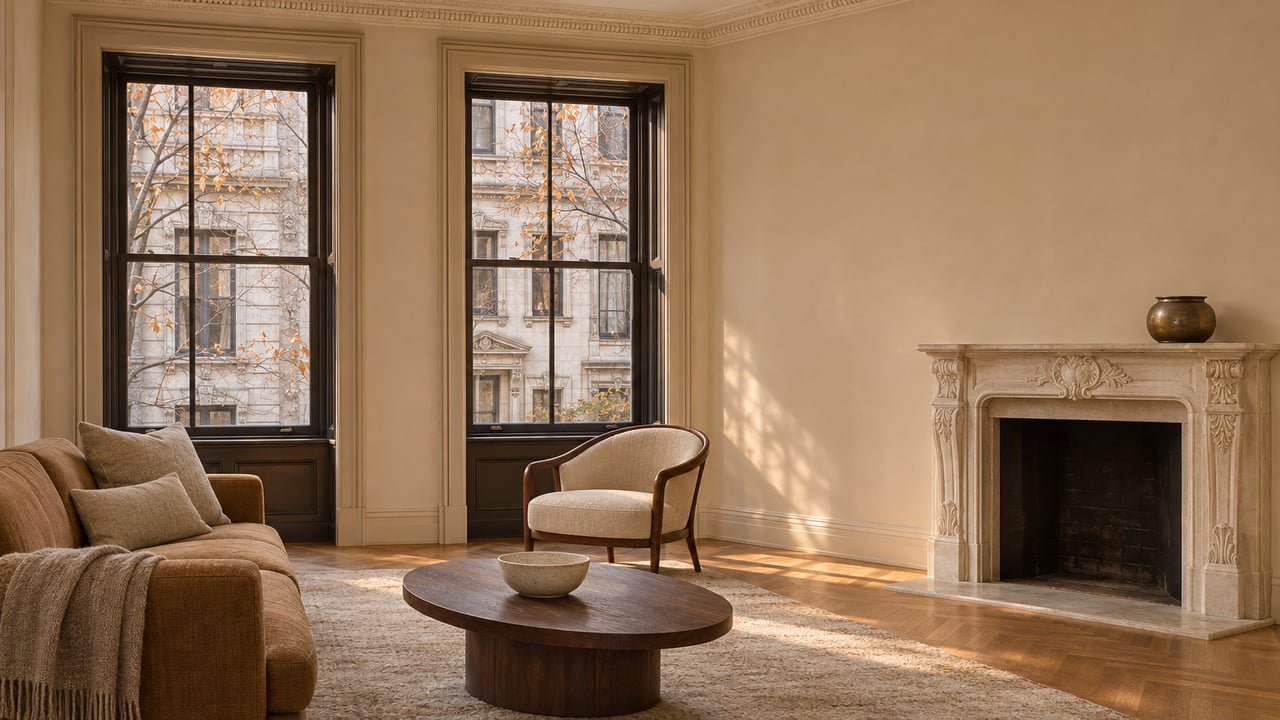
In 2009, a buyer paid $8.3 million for 67 Charles Street, a four-story West Village house built in 1867, and later had it gut-renovated. It came to market asking $20 million in 2020 and was relisted at $25 million in April. In the week of October 5 to 11, it went into contract with an asking price of $22.5 million, The Real Deal reported. The house is 20 feet wide and 6,000 square feet, with an elevator, a garden and a roof terrace.
Two months earlier on the Upper East Side, another 20-foot-wide house at 111 East 81st Street went into contract asking just under $14 million, according to The Real Deal's weekly luxury roundup. It has four stories and 6,500 square feet, plus an elevator, a roof terrace and a back garden. It has more space than Charles Street and similar features, and its ask was roughly $8.5 million lower.
In Harlem, 265 West 139th Street on Strivers' Row closed at $2.8 million this year. It is a Stanford White design completed in 1893: 19 feet wide, about 4,500 square feet, four floors plus a cellar.
These are three houses of nearly the same width, and their prices run from under $3 million to more than $22 million. This explains the headline figure Manhattan townhouse buyers saw this fall, and it changes how two neighborhoods should be compared.
Four Houses, Held to One Width
Width is the dimension that is hardest to change on a Manhattan row house. You can renovate the interior, add a roof terrace or put in an elevator, but the lot width stays the same. That makes it the most useful common unit for comparing neighborhoods.
| Address | Neighborhood | Width | Size | 2026 price | Approx. per sq ft | Approx. per foot of width |
|---|---|---|---|---|---|---|
| 67 Charles Street | West Village | 20 ft | 6,000 sq ft | $22.5M ask at contract, October | $3,750 | $1.1M |
| 48 Jane Street | West Village | 22.5 ft | 4,100 sq ft | Just under $15M ask at contract, September | $3,650 | $665,000 |
| 111 East 81st Street | Upper East Side | 20 ft | 6,500 sq ft | Just under $14M ask at contract, August | $2,150 | $700,000 |
| 265 West 139th Street | Strivers' Row, Harlem | 19 ft | 4,500 sq ft | $2.8M closed | $620 | $147,000 |
The three fall contracts are asking prices at the moment of signing, not recorded sale prices, so the per-foot columns are approximate. Even so, the spread is large. Per square foot, the Charles Street house asks about 1.7 times what East 81st Street asks, and about six times what the Strivers' Row house sold for. Per foot of width, the gap from Charles Street to Strivers' Row is more than sevenfold.
The Strivers' Row figure matches the norm for its block. The listing agent told the New York Post that houses on the two-block enclave usually trade between $2 million and $3 million, which puts this sale near the top of the range. The house kept six decorative fireplaces, inlaid hardwood floors, period moldings and a wood-paneled entry vestibule, and it added radiant-heated bathrooms. Like the downtown houses, it is a finished, livable home.
Why the Borough Median Fell While Supply Tightened
This fall's Manhattan townhouse headline pointed the other way. In the third quarter of 2026, townhouse listing inventory fell 33 percent year over year and the median townhouse sale price fell 21 percent to $5.4 million, according to Hoodline's summary of appraiser Jonathan Miller's data for The Real Deal.
Miller's own Q3 2026 commentary explains it. In the third quarter, the average Manhattan townhouse that sold was 4,552 square feet, 7.9 percent smaller than a year earlier, and that smaller size pulled all three of his price measures down. In the same quarter, months of supply, the pace at which listings are absorbed, was the fastest in more than four years. Houses were selling faster, and the houses selling were smaller.
In the second quarter the effect ran the other way. The Real Deal reported that the average one- to three-family home sold in Q2 2026 was more than 5,000 square feet, up nearly 15 percent year over year. That was the quarter the 14,000-square-foot double house at 105-107 Bank Street closed at $70 million. Spring looked like a boom and summer looked like a pullback, but the market was tightening the whole time. The mix of houses that happened to close was what changed.
Townhouses make up about 2 percent of Manhattan residential sales, and Miller notes that almost none are being built because buyers want authentic turn-of-the-century structures, even ones gutted to the party walls. With a fixed stock and a small number of trades, a borough median mostly reflects which houses traded. The table above is more useful. It shows that the same width costs very different amounts depending on the neighborhood.
Condition and Purchase History Explain the Rest
Width sets the comparison, and neighborhood accounts for most of the gap. Two other factors account for what remains: what has been done to the house and what the current owner paid for it.
On the Upper East Side, 160 East 81st Street is twice as wide as its neighbor at 111, at 40 feet. It has more than 7,600 square feet over four stories, a 40-by-48-foot garden, a private garage and a wood-paneled library. It sold this year for $23 million against a $26 million ask, The Real Deal reported. The owner had paid nearly $23 million in 2021 and then had it redesigned by Williams Lawrence. That works out to about $575,000 per foot of width, below the roughly $700,000 per foot asked at 111 East 81st. On this block, the wider house cost less per foot of frontage, and five years of ownership plus a redesign ended at about the original purchase price.
The house at 111 East 81st shows a different pattern. It sold for $13.3 million in 2022, listed at $15 million in May 2026, and went into contract just under $14 million. The ask at signing was close to what the owner paid four years earlier. On East 81st Street this year, the redesigned 40-footer closed near its last purchase price, and the 20-footer went into contract at an ask near its own.
The West Village houses show what holding a house for a long time looks like. The 67 Charles Street buyer paid $8.3 million in 2009, then gut-renovated the house. The owners of 48 Jane Street have held that house since 1996, when it passed through an estate, The Real Deal reported. They renovated it with the architects Fairfax & Sammons, and it has five bedrooms, skylights, wood-burning fireplaces, a back garden and a cellar. It first asked $15.5 million and went into contract just under $15 million. When a seller's basis is that old, the asking price reflects the neighborhood's current price, not a number the owner needs to recover.
The Strivers' Row house listed at $3 million last August, took a $250,000 reduction in January, and went into contract soon after. The listing agent told the New York Post that buyer interest picked up in the spring, but prices in that category remain below pre-pandemic levels.
Size matters again at the very top of the market. The Upper West Side's record townhouse sale this year, 48-50 West 69th Street, closed at $45 million, about half its $85 million original ask. The Real Deal described it as 38 feet wide, 19,600 square feet and eight stories, with extensive renovation. At about $2,300 per square foot, a neighborhood record still priced each foot of interior near the East 81st Street ask. The total was high because the house is very large.
The Contract Count Since Late September
On the borough's weekly luxury report, the fall season has started steadily. The Real Deal's weekly roundups of Olshan Realty's data count Manhattan townhouses asking $4 million or more that went into contract:
- September 21 to 27: three townhouses, with 48 Jane Street the priciest home of the week across all property types.
- September 28 to October 4: one.
- October 5 to 11: three, including 67 Charles Street.
- October 12 to 18: four.
- The week reported October 26: four.
- October 26 to November 1: five.
- November 2 to 8: four.
That is 24 townhouse contracts in seven weeks, after a September in which luxury contracts of all types totaled 65 over four weeks against a ten-year average of 71 for the month. With a third fewer townhouse listings than a year ago, steady weekly contracts leave buyers with fewer houses to choose from on any given block.
For a buyer comparing the West Village with the Upper East Side, or either one with Harlem, a borough figure has limited use. The more useful comparison is what 20 feet of frontage cost on the block they want this year, how the house's condition compares with that benchmark, and what the seller paid. On East 81st Street in 2026, one sale and one contract ask landed near the owners' purchase prices. On Charles Street and Jane Street, owners who bought long ago priced at the neighborhood's current level. On Strivers' Row, the top of a $2 million to $3 million range held even after a reduction.
FAQ
Is the 21 percent drop in Manhattan's townhouse median a sign that prices are falling? Miller's third-quarter 2026 data attributes the decline to a smaller average house size, which fell 7.9 percent to 4,552 square feet. In the same quarter, inventory fell 33 percent and the market pace was the fastest in more than four years.
Are the fall contract figures final sale prices? No. Charles Street, Jane Street and 111 East 81st Street are asking prices at contract, as reported weekly. The final figures appear once the sales close and are recorded.
Does more width always mean a higher price per foot? Not in this year's examples. On East 81st Street, the 40-foot house sold for less per foot of frontage than the 20-foot house down the block asked in August.
Bill and Guy handle townhouse sales across Manhattan. If you own a townhouse and want to know where yours falls on that scale, given its width, condition and purchase history, request a complimentary home valuation, and we will price it against the houses that actually traded nearby. Sellers planning a spring listing may also want our notes on timing a Manhattan townhouse sale.